

Singing Through Labor: What Your Voice Can Do That Nothing Else Can
Art by Amanda Greavette
Most people don't think of their voice as a birth tool. They think of breathing techniques, water, movement, a trusted support person, maybe medication. These are all good and real and useful, but there is something the voice can do in labor that nothing else quite replicates.
I have come to see the experience of birthing as a magnificent spring rainstorm. The bright sky softly turns grey, then darker, and the rain builds until the powerful and exciting deluge descends in full force. In the calm that follows, the world is reborn. Each birth is unique and yet they all follow this basic pattern, and one of the most common complications that interrupts that pattern is stalling, when labor slows instead of steadily strengthening.
In my own second birth, it was having my mother near and singing that reengaged my emotions and brought back my contractions. I was grateful to have simple, supportive songs within me. “I know this rose will open. I know my fears will burn away. I know this soul will unfurl its wings. I know this rose will open.”
Why it works
Sensing danger stalls the birthing process. Women evolved so that perceptions and emotions control the hormones that turn labor on or off, which means that the body's felt sense of safety is not incidental to birth but central to it. Singing tells the body that all is well.
There is also a direct physiological relationship between the jaw, the throat, and the pelvic floor. Open, low, resonant sounds work with the body's architecture in ways that tight or high sounds actively undo. In transition and pushing, high sounds are connected to resistance and even cervical constriction, while sighing and soft or loud moaning extend the breath, support muscle relaxation, and encourage cervical opening.
Ina May Gaskin, mother of modern midwifery, has said: the energy that gets the baby in is the energy that gets the baby out. Birth benefits from a cocoon of soft lighting, gentle touch, and soothing sound.
The lullaby bridge
There is also something beautiful that can happen before labor even begins. Babies can hear and respond to music as early as 27 weeks gestation, and when a song is sung to the baby regularly in utero, the baby can recognize it at birth and receive comfort from it. What a way to be welcomed into the world, with a song already known.
You don't need to be a singer
Birth singing support has nothing to do with musicality or carrying a tune and everything to do with having sounds available to you before labor begins, so that when you are in the middle of it the voice is already a familiar tool, already something you trust.
For a much deeper look at singing through pregnancy, birth, and early motherhood, including song suggestions for every stage and the research behind them, visit my FREE Songbirth ebook.
Welcoming your baby with a song?
I offer personalized childbirth voice sessions in Olympia Wa and online. Your voice is always with you. I hope to help you develop a relationship with it that provides spontaneous support to your birthing and parenting journey.
Your Voice Knows Who You're Becoming
Your Voice Knows Who You're Becoming
There's a version of you that isn't quite here yet, someone who speaks up sooner, whose warmth comes through more clearly in a room, who holds their ground without hardening. You can probably feel this person at the edges of your life, glimpsed in good moments and then gone.
The voice tends to get there first.
Before a new way of being settles into personality, it often shows up in sound. A client experiments with a deeper, more grounded tone, not because she's faking confidence but because she's curious what it feels like. Something shifts and she notices people listen differently. The sound becomes familiar, and familiar becomes real. When I found my ‘frog voice’, these deep sounds took about a year to integrate into my singing but they unexpectedly integrated into my self knowing as well. I was more able to handle forms of conflict I spent my life avoiding, and I learned to call upon these deep sounds to ground me.
This is not manipulation or pretense but how change actually works. We try things in small, low-stakes ways before they belong to us, and the voice is one of the most available places to do that trying.
Sound as experiment
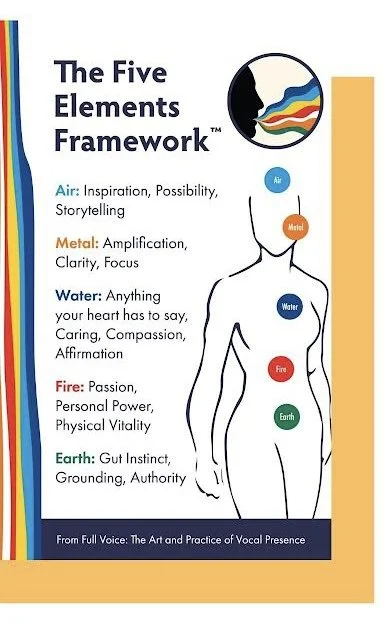
The Full Voice method works with five elements, each one a different quality of expression that lives in the body and voice. Earth carries gut instinct, grounding, and authority. Fire is passion and personal power. Water is the heart, compassion, caring, everything your heart has to say. Metal brings clarity, amplification, and focus. Air opens into inspiration, possibility, and storytelling.
Most of us have spent a lifetime more comfortable in some elements than others. A person who lives mostly in Metal, clear, precise, and focused, may have learned early that clarity was safer than tenderness. Experimenting with Water for the first time, letting the heart actually come through in sound, can feel vulnerable and then surprisingly relieving. Something that was protected begins to soften, not because they decided to change, but because the voice opened the door.
That's the experiment. Low stakes, just sounds, and then sometimes quietly, newness flows into assuredness.
The voice you haven't met yet
Most people have a much wider vocal range than they know, not just in pitch but in quality, texture, and presence. Sounds they've never made because no one invited them to, or because something old said not to. Those uninvited sounds often carry uninvited possibilities, a softness that was protected behind efficiency, a strength that was waiting behind politeness, a playfulness that got buried in work.
Finding them doesn't require a performance, just a little curiosity and someone to witness the experiment without judgment.
You don't have to know who you're becoming
That's actually the best way to begin, not with a destination but with a willingness to make some unfamiliar sounds and notice what they know. The voice tends to be a few steps ahead, and tuning in is enough.
Ready to meet your voice?
I offer vocal coaching in Olympia, WA and online. If any of this resonates, I'd love to hear from you. The voice that's waiting for you is already there.
When the Goal Is Met, What Comes Next?
Most people come to voice work with a goal. Sing more confidently. Stop losing my voice by midweek. Find out if I can actually carry a tune. These are good reasons to begin and reaching them is genuinely satisfying. For many people, that's exactly enough and they carry it forward on their own.
But sometimes something else happens.
The goal gets met and then the voice of possibility speaks. What other sounds can I make? Where do my sounds and my personality meet? If I expand my sounds, will my life expand in some way? Something loosens that had been held for a long time. The voice that was supposed to be a project starts feeling more like a companion.
This is a different kind of work. Slower, less linear, harder to measure. It doesn't happen on a schedule and you can't really plan for it. It tends to find those who stay curious after the original question has been answered.
What long term voice exploration actually looks like
I know this territory from two directions, as a teacher and as a student of my own voice.
My voice has been a companion and guide for as long as I can remember. It has shown me things about myself I wasn't looking for. When I began working with the metal element, I heard myself whining and understood for the first time that I was genuinely bothered by something I'd been glossing over. When I expanded my vocal register five notes down into the earth voice, I also found a new strength of self worth. That kind of information and transformation doesn't come from a goal. It comes from a relationship that has had time to develop trust.
I've had the privilege of guiding voice work that spanned more than a year, long enough to watch this shift happen in real time. From arriving with specific intentions to following the voice itself into less charted territory, I accompanied one client through her relationship with physical pain, relationship with partner, place in community, work life, and self actualization via passion project, all through the voice.
This isn't for everyone and that's fine
If you come, meet your goals and feel complete, that's wonderful. Voice work doesn't have to be a long journey to be worthwhile. But if you find yourself still curious after the original question is answered, that curiosity is worth following. The voice tends to keep giving when we keep listening.
You can also think of your voice as part of your overall wellbeing, worth checking in with seasonally or once a year, the way you might tend to any living relationship. A single session can be enough to reconnect and recalibrate.
You Don't Have to Be a Singer to Work with a Vocal Coach
There's an assumption that vocal coaching is for people who sing and who are polishing something already in progress, preparing for a performance, or climbing some ladder of musical achievement.
That's not who I mostly work with.
Many people who find their way to my studio were told at some point that their voice wasn't quite right, or they were simply never invited into singing at all and decided it wasn't for them.
Others come because their speaking voice isn't working the way they need it to. A teacher whose voice gives out by Wednesday, a therapist who wants more warmth in how they're heard, or someone who just feels disconnected from themselves in a way they can't quite name.
The voice as a way back to yourself
People watch dramas to feel something. To be moved, stirred, reconnected to their own emotional life after a week of going through the motions. It works but it's borrowed feeling. Someone else's story, someone else's voice carrying you on a much needed escape.
Working with your own voice can be as exhilarating as it might seem terrifying in anticipation. The aliveness that results is yours. It doesn't fade when the episode ends. Like any real relationship, getting to know your voice isn't always comfortable. Sometimes it shows you something you’d been successfully ignoring. While it can be awkard at first, it's usually the most useful part. People describe feeling more present, more grounded, more like themselves. A freshness that ripples into ordinary life in ways that are hard to predict and fun to notice.
This is not a small thing. It's actually one of the reasons I do this work. When I began inviting the ‘metal’ voice into my speech, I heard myself whining and then realized that I was actually bothered by something. This is how the voice reveals us to ourselves.
What "good at singing" even means
The voice isn't an instrument you either have or don't. It's a living system connected to your breath, your body, your history, your nervous system. "Good" and "bad" are judgments that mostly reflect what someone was told or not told, encouraged or discouraged, early on.
In the Full Voice method I work with, there are five elements of the voice: earth, fire, water, metal, and air. Most people are more comfortable in some than others. Finding where your voice is free, and where it's held, is the whole project. That's true whether you've sung in choirs your whole life or haven't made an intentional sound since third grade.
If feeling 'good at singing' is your goal, we can absolutely work toward that. What helps most is getting to know you, your voice, your history, and your vision so that our time together actually aligns with your path rather than someone else's idea of what a voice should be.
You don't need a reason beyond curiosity
You don't need a goal. You don't need a problem to solve. General curiosity about your own voice is more than enough to begin.
What you might find is that your voice knows things about you that you haven't gotten around to knowing yet. That's not a problem, it's an open door.
Ready to find out what your voice knows?
I offer vocal coaching in Olympia, WA and online. If any of this resonates, feel free to reach out. I hope to help you love your voice.
What to Expect in Your First Vocal Coaching Session
If you've never worked with a vocal coach before, it's natural to wonder what you're walking into. Will you be asked to perform? Will someone judge your voice? Will it feel like a music lesson from fourth grade?
The short answer: none of the above.
It starts with a conversation
Before we do anything with sound, we focus on what is bringing you to the session. Maybe your voice feels tight or tired. Maybe there's always been a wish to sing but something gets in the way, or your voice doesn’t quite fit your profession in some aspect. You might have a clear reason or goal but you also don’t need one. General curiosity about your voice is a great place to begin.
I'll ask about your vocal history of singing and speaking, as past vocal experiences can have a long reach. The body/mind connection is especially interesting when it comes to the voice. The whole body is the vocal instrument, including our thoughts and feelings, and it’s important to begin where you feel comfortable.
This is also a two-way conversation. Questions about my background and my approach can help you get oriented and are all welcome.
It can be reassuring to know that first sessions typically have more conversation than follow up sessions and that the pace and focus are entirely up to you. Beginning with a rich context better aligns future sessions to your meet needs, and a discounted pack of four sessions is the most popular choice, but single sessions are useful. It helps to know if you want a single session upfront so that we can try to fit more into that time instead of going in depth. If you aren’t sure, I recommend treating the first session as one of possibly more and see where it goes. You will get the five elements exercises, personalized feedback, and follow up resources from either approach.
Then we make some sound
Not a performance. Not a test. Just exploration. We begin with the five elements (earth, fire, water, metal, and air) of the voice, which I explain and demonstrate. I invite you to make sounds along with me and when you are comfortable, to continue making sounds yourself. Hearing your own sounds gives your ear more direct feedback and often helps tune into the experience. I will ask you what you notice about making each sound and I’m interested in your unique experiences. I might ask you further questions, to hum, or sustain a tone, or try something that feels slightly strange and then notice what shifts. My methods are playful and body-based. It's about finding where your voice is free and where it's held, and exploring ways to find more freedom.
Sometimes people are surprised by what comes up. I am not a therapist but vocal work is therapeutic. I trust that you will only bring up what you are comfortable discussing, and if emotions arise they are welcome. Most people leave feeling more spacious than when they arrived, especially after follow up sessions.
You don't need to prepare anything
No song to practice, no scales to memorize. Bring your water or tea if you like. Comfortable clothing is best.
What people often notice afterward
With the five elements in mind, people often hear voices with a fresh ear. Understanding this vocal framework can lead to increased awareness of oneself and others.
It is also common after a first four pack of sessions to realize that you could do more than you thought. Goals might shift or multiply to meet your changing view of your voice and how you use it.
Interested in getting to know your voice better?
I offer vocal coaching in Olympia, WA and online. If you're curious whether this might be right for you, feel free to reach out. A conversation costs nothing.
My voice is a beloved friend who rescues me, knows me better than myself sometimes, and brings me great joy. Every voice is vast and magical. I hope to help you love yours.